Tuesday, 24 May 2011

Promises, promises and a quick visit to Chelsea Flower Show

I have started the summer planting, honestly I have. The ones I have done mainly involve plants which were desperate - I had a whole trayful of Lathyrus sativus 'Tutankhamun' which had knitted together horribly and gone a bit yellow at the base. I decided to mix these in with some other plants and I will wait until they have recovered a little before I photograph them. I hope they will recover because they have gorgeous almost turquoise blue flowers with pink veining... Sorry, you'll just have to wait a while.

Alpines beginning to overflow
Remember that alpine planting I did a while ago and then it got knocked over? The plants are romping away now - I can see that I'll soon have to remove or split a few of the plants as it is going beyond luxuriance and becoming shapeless now.


Allium cristophii and Pansy 'Can-can'
Allium cristophii's metallic flowers are gleaming in the stockyard pots. The beds in the courtyard garden are well stocked with Allium 'Globemaster' and the delphiniums are beginning to come out, bursting through cushions of Phuopsis stylosa and geraniums. The overflowing flowerbeds take over from the pots a little now, which gives me a bit of breathing space for replanting the pots.


Mood music
It's at this time of year that the staff linger outside for as long as possible over break and lunch. On Thursday Simon (one of our throwers) brought his new guitar in and we persuaded him to play outside, making the garden even more idyllic.

Ladies and Gentlemen please welcome Mr Simon Day and his 12 strings
Change of tempo
Jim Keeling with his Golden Cypress
I have just come back from a much less peaceful scene - Chelsea Flower Show. Yesterday morning I joined the London commuters on the 6.15 from Moreton-in-Marsh; we aren't exhibitors this year but Hillier has used Jim's latest sculpture, the Golden Cypress, on their huge stand in the marquee, and I was offered a spare ticket for Press Day.

Jim's extraordinary creation is so large and complex that it involved just about everyone at the pottery, firing, spraying, hand-gilding, manoeuvring and packing it for its journey. Now it gleams from amongst Hillier's wonderful collection of trees and shrubs.

Today (Tuesday) we have learnt that for the 62nd year in a row Hillier has achieved a gold medal. Well done everyone!

I left Jim to talk to possible customers and went to inspect this year's crop of gardens and exhibits.

Do I know you?
Press day is also celeb day so I was distracted to a certain extent because I kept seeing people I thought I knew. Some, such as Ringo Starr, attracted swarms of photographers, others managed to be more discreet. I suddenly realised I was standing next to Dame Maggie Smith while we both scrutinised Andy McIndoe's planting on the Hillier exhibit. A photographer thanked her for allowing him to snap her, "Well I didn't have any alternative" was her slightly acerbic response.

Even though she obviously had a book to plug I couldn't help feeling slightly sorry for Gwyneth Paltrow as she was pushed out to walk across  the B&Q garden towards an army of paperazzi (standing on chairs they'd pinched from the exhibitors' restaurant). She did look a bit sheepish.

Gwyneth Paltrow runs the gauntlet

I bet she's looking forward to her shower.

Many other gardens opted for living sculptures with slightly lower profile. Having decorative people in your garden may make for entertaining photos but it does rather distract from the garden. In some cases I suppose it did make up for a genuine lack of interest but in many I thought it was a shame that even keen gardeners like me were being distracted from the plants and design by all the shenanigans. The fiercest competition at Chelsea is for the prize of publicity, however, so the gloves and sometimes a lot of other clothing, are off.
A little t'ai chi in the garden?


There was some clever planting. I always enjoy Cleve West's gardens so I wasn't surprised to find myself drawn to his even before I knew who had designed it. His gardens always seem warm-hearted and useable, whereas some Chelsea show gardens can be stylish but cold.


Cleve West's garden at Chelsea. Gold, Best in Show.

 I also enjoyed the blend of colours in Luciano Giubbilei's garden, a designer I don't remember seeing before.

Planting by Luciano Giubbilei Gold Medal


Planting by Tom Hoblyn
The colour combinations in Tom Hoblyn's planting were fresh and clean and not often seen at Chelsea. There was beautiful stonework and woodwork in all of these gardens and many more but I'm afraid I naturally get more excited about the soft landscaping than the hard landscaping - and, by the way, I saw no exciting container planting at all. Can't help thinking we should do a garden some time!


So it follows that I usually spend more time inside the marquee than outside. I was very pleased to see that Hardy's Cottage Garden Plants had chosen to exhibit their beautiful Anemone 'Wild Swan' in a Whichford pot. We learned this morning that this has been voted Plant of the Year. I'd like to think the pot helped...

Anemone 'Wild Swan' in a Kitchen Garden pot
Plant of the Year
Anemone 'Wild Swan'


So if you visit Chelsea this week please have a look at the Whichford contributions - and enjoy the show.

Your chance to gather some more ideas
By the way Andy McIndoe - who masterminded the spectacular Hillier stand - is coming to the pottery on Saturday June 11th to talk on "Form, Foliage and Flowers", tickets are still available so why not take the chance to hear from someone with a phenomenal track record of growing and exhibiting plants?

I'll be talking the next day (June 12th) on "Pots for Special Occasions" so I really hope to see some of you there - I hope to be able to give you some inspiration for summer plantings. Just call the Pottery on 01608 684416 or see the website for details.
The Golden Cypress
Hillier gold medal-winning exhibit, Chelsea Flower Show

Monday, 16 May 2011

Viola time is nearly over but the birds are still going strong

Pansy 'Can-Can' still colourful but getting scruffy.
Allium karataviense 'Ivory Queen' in the seed pan at bottom right.
Pansies and violas have done a sterling job but are now just reaching the borderline between luxuriance and scruffiness. It seems a shame but Babs and I are just about to start ripping them all out and planting up all the summer stuff.

Fluffy balls
Alliums are still looking good: Allium karataviense 'Ivory Queen' has been attracting a lot of comment from visitors to the pottery. Unlike most alliums this has neat leaves which look sculptural and interesting as soon as they emerge and stay in pretty good shape while the flower - like a fluffy white tennis ball - expands. So it looks great by itself in a pot, preferably with a gravel or pebble mulch covering the surface of the compost.


Violas in a small fritillary pot
We won't empty all the pots at once, the changeover process will take from now until July probably. I'll keep the best survivors until last. The violas will go on the compost heap, some bulbs will be saved, others composted. All the shrubs and perennials will be potted up in plastic and kept for use next autumn.

Waiting in the wings
I've been having difficulty hardening plants off in this sunny but cool and windy weather so the polytunnel is bursting and it is almost impossible to walk through the greenhouse now. I leave the doors of both open during the day and now the polytunnel is open at night as well. It has doors at both ends, so hopefully the plants in there will not find outdoor conditions too much of a shock.

The polytunnel jungle

Hardy annuals such as marigolds are easy to harden off, Linaria 'Spanish Dancer' was positively relieved to get out in the cool air this year. You have to be extra careful with more tender subjects, however, plants like Tithonia rotundifolia and Morning Glory (Ipomoea purpurea) will simply stop growing if exposed to cool temperatures too suddenly.

Le rouge et le noir
Having said that I have been sneaking a few tender things out already. One of my favourites is Pelargonium ardens, with small but astonishingly, properly, red flowers, each petal having a dark mark which invites you to grow black plants with it such as Aeonium arboreum 'Zwartkop'. It seems to like relatively cool conditions so it is one of the first of my pelargoniums to be allowed out.
Pelargonium ardens in a Frilly Lily pot


Pot to Plate
On Friday and Saturday we had one of our special events, "Pot to Plate" with guest speakers Sophie Grigson (well known for, amongst other things, urging people to Eat Your Greens), and Chris Smith from Pennard Plants. Chris gave a really informative and interesting talk on growing edible plants in pots. I found it satisfying because he confirmed many things I have found for myself by trial and error (it's always reassuring when that happens) and he was obviously comfortable with growing plants in terracotta generally.

You'd be surprised how many gardeners are prejudiced against terracotta because they have been told it is difficult to keep watered. I shall rant about this in more detail another time but take it from me it is no more difficult than using less porous containers, in fact in my experience it is easier. One of the things we agree on is that it is not helpful to line terracotta with plastic (advice parroted in some surprising publications).


Chris Smith talking at Whichford Pottery.  Photo by Lynda Dyer
At Pennard Plants Chris grows a wide range of herbs, salads, vegetables and fruit, so he was full of useful suggestions for suitable varieties and combinations (too many to list here I'm afraid...) and brought plenty to sell too. I often use edibles mixed with the ornamental plantings but listening to Chris has made me think that maybe we should find a space for a potted potager of some sort. Maybe next year as I have planned all this summer's spaces already. Food for thought anyway.

Mrs B the blackbird on her nest.
Avian triumphs and disasters
We were also excited last week because Mrs B built a beautiful nest in a wall pot and was firmly sitting in it on Thursday despite the fact that it was right next to a busy path. And we were so disappointed to find on Friday morning that the nest had been raided (jackdaws probably) and little blue eggs were spattered on the path.

She has already raised one brood but she normally does three or four as far as we can tell. I'm glad to say that she is all right and has been busy building in the rose on the wall of the pottery, let's hope the thorns deter predators.


There are other birds all over the place. As I drive to work in the morning yellowhammers and goldfinches burst up from the road. The friendly robin has raised a brood successfully and was escorting them about on the compost heap this morning. A few days ago there was a fledgling robin in the greenhouse - they seem to get the hang of finding their way out relatively quickly, luckily.

Baby robin in the greenhouse
This morning the wren was singing well above its weight (how does such a small bird have such a loud voice?) perched in the backup stock area. I'm not sure where it is nesting but there is usually one living around the sheds somewhere.
Wren in backup.
After a little much-needed rain growth is lush and it is getting harder to move stock along the paths, nevertheless the birds are not the only ones to be busy here and despite the upheavals of summer special events our amazing making team is managing to produce plenty of stock - I think you'll agree it looks fantastic even before it is planted!

Sunday, 8 May 2011

Deadheading in the rain

Rain at last! This means goodbye to almost all of the tulips, and this year Tulip 'Queen of Night' wins the prize for last tulip standing - or rather leaning - and very delicious it looks too, bedecked with raindrops.

Tulip 'Queen of Night'


Tulip 'Picture' in a Great Warwick Pot
Tulip 'Picture' is one of the latest to colour up and has lasted as long as 'Queen of Night'. It isn't to everyone's taste, being such a strangely curly tulip, but it it has strong stems and a clear colour and is one of the sturdy, tall tulips that I can safely recommend to people who are nervous of tall plants in pots and think that everything "suitable for container planting" should be stunted and squat.
Tulip 'Carnaval de Nice' in a Basket Lily Pot
I'm writing this at home, so I can't see, but I am pretty sure that Tulip 'Carnaval de Nice' will have been dashed to pieces by the heavy rain; a few days ago it had opened as far as it possibly could and once tulips have done that the tepals are much more likely to be knocked off by wind, rain, dogs, children, handbags, hosepipes and the fairies at the bottom of the garden.

Off with their heads.
Now is the time to dead-head them. If you only have limited time just make sure that you snap the developing seed-heads off the tulips so that the bulbs don't waste energy on seed production and have a better chance of producing flowers next year. It is, however, worth going further than that: I always underplant tulips with other plants, especially violas and pansies, and in order to keep these in good enough condition to rise up and take over from the defunct bulbs I normally cut the tulip stems down to just above the first big leaf.
Cutting off tulip stems
In theory this does reduce the amount of energy going back into the bulb, but I want my plantings to look good until it is safe to get all the summer bedding out of the greenhouse. Most of our tulip bulbs either go on the compost heap or get planted in my or Jim's gardens, so I don't really mind if they are a little bit weakened. My priority is to keep the other plants happy, so if some of those big floppy tulip leaves are sitting on them I will take those off too by twisting them at the base.


Removing a lower leaf

Before - the remains of the tulips dominate
This means that the plants around them get more light and air and will soon fill the space and carry on flowering. I try to remove just one big leaf per tulip to give it a sporting chance. Doing this and making sure the violas are dead-headed regularly will make your pots look better immediately, it prolongs the display and you will get your money's worth out of your plants instead of letting the bedding languish and rot under dying bulb leaves.

Where did those pop up from?
It's amazing what a visual distraction the redundant tulip leaves and stems are. As soon as you remove them you will find that people suddenly start to notice the other plants in the pot.

After - Blue conifer Chamaecyparis pisifera, Violas, Anemone blanda 'White Splendour', Pinks and delicate white Allium cowanii can all see the light of day again

The four pictures above were taken at my house, so you won't see this potful at the Pottery but there is plenty more to see there at the moment. I have just recently taken the two Echium pininana out of the polytunnel and put them in the courtyard garden - these are officially biennials but I have had to keep them going for three years until finally they decided to flower.

Echium pininana


Echium pininana is the kind of thing you might see on the mild coasts of Cornwall growing outside, but in darkest Warwickshire it needs to spend the winter in shelter. Pots are a great way to extend the range of things you can grow, many tender-ish plants can be sheltered in garages, summer-houses or porches if you don't have a greenhouse or polytunnel.

Tasty trilliums
And finally I'll leave you with the still-fresh Trillium chloropetalum  - I have a small collection of Arisaemas and Trilliums at the Pottery, which do surprisingly well in pots in shady areas and help to provide interest during the pause between the tulips and the lilies. If you have a crowded garden - as most plantaholics do - pots can be a good place to keep such unusual treasures because they disappear so thoroughly when they are dormant that it is easy to lose them in flowerbeds.
Trillium chloropetalum with Heuchera 'Key Lime Pie'

Oh all right, here's one more - this is a pot of Trillium flexipes, photographed last week. Sometimes it's best to keep things simple.
Trillium flexipes in a Long Tom

Wednesday, 27 April 2011

Late tulips and pricking out seedlings

Gorn! And never called me Mother!
Hot weather and wind has done for 'Prinses Irene', she has a severe case of alopecia. 'Backpacker' has been fried and 'Princesse Charmante' is a distant memory. 'Mount Tacoma' is ageing in a pleasantly blowsy way but isn't long for this world.

Tulip 'Mount Tacoma'

Last tulips standing
There are some tulips which get going a bit late and I am grateful for this because the hot weather could have meant that tulip time was a bit of a flash in the pan this year. 'Carnaval de Nice' is looking fresh and crisp at the moment.

Tulip 'Carnaval de Nice' in the Basket pots outside the store-room

It does have a tendency to lean out of the pot but it rarely snaps and I enjoy the way tulips like this can bend and twist around. In the case of 'Carnaval de Nice' it means that you often get a good view of the beautifully painted back of the flower. 

Tulip 'Carnaval de Nice'

'Esther' is still looking perky. This tulip has beautiful blue-green blotches inside the flower, it's always worth looking inside tulips because there is often a bonus colour hidden there.

Tulip 'Esther'


Tulips 'Picture', 'Esther' and 'Blushing Girl'
So some tulips are still hanging on and with a bit of luck there will be plenty left for the participants in Liz Eddison's photography course here on Saturday. There are also trilliums, alliums, arisaemas, violas, pansies, wallflowers, echiums, alpines, daisies....
Fresh Hostas in Hosta Pots
We mustn't forget the fresh limey greens that make the spring palette special. I have a collection of hostas, mostly in our Hosta Pots (the shape shows them off and snails really hate climbing the overhang!) and having just unfurled they are at their brightest. Most of the variety names are lost in the mists of time but who cares?

Getting warmer.
Unfortunately even in the unseasonably hot weather I have been sweating in the greenhouse. Seedlings are still spewing out of the propagator and I am having trouble potting them up fast enough. We are now getting to the stage where the only way to get from one end of the greenhouse to the other is sideways and holding your breath.

So here is my basic pricking out technique:
I use 9cm pots and usually work in batches of twelve, pricking out three or four dozen plants of each variety. Here I shall be working on Amaranthus 'Illumination'. As a general rule the younger the seedling the easier it is to prick out, as the roots will not have branched out and tangled together. Try to do the pricking out before the roots reach the bottom of the seed tray.

1. Scoop compost into the pots and tap each one twice on the bench to settle the compost down. Sweep the excess off with the flat of the hand but do not press down on the compost. Fill a whole batch of pots this way.

2. I often sow seeds in the trays that bedding plants come in so that it is easy to remove a small batch at a time. If using a normal seed tray gently ease a managable chunk of seedlings out and work on that rather than trying to dig each seedling out individually.


3. Now gently split this chunk into smaller chunks, taking care to ease the compost apart. This compost is a bit wet; it is easier to crumble the seedlings apart if the compost is not too soggy but it must be damp or the roots and particles of compost will cling together and have to be ripped apart.


4. Gently squeeze the chunk of compost so that it starts to break apart. You are aiming to tease out an individual seedling with as little damage to the root as possible.

5. Now you can ease away a seedling. Handle it only by its seed-leaf (if you damage the stem it may not recover). Try not to break those roots. It should come away with only a little compost clinging to the finest roots. You'll get better at this with practice!


6. Make a hole in the compost with the forefinger of your other hand big enough to accommodate the seedling's roots and lower it gently in. The roots need to drop into the hole without being folded upwards.


7. Lower the seedling in until it is very slightly deeper than it had been in the seed tray then firm the compost around it very gently. Tap the pot on the bench a couple of times to settle it in. Pressing on the compost squeezes the air out, tears those fragile roots and may damage the base of that delicate stem.


8. Place the pots in a couple of inches of water and leave only until moisture is just beginning to show at the surface then remove promptly. It should only take a few minutes. Watering from above tends to squash the seedling into the compost and may even break it.


9. Put the pots in neat rows on the greenhouse staging. This is not just for your own satisfaction, it is much easier to water straight rows of pots consistently. Don't forget to label each batch.


10. Watch them grow!


Seedlings and cuttings in the greenhouse this week


Thursday, 21 April 2011

Tulipomania and Ruthlessness

What an amazing couple of weeks it has been. The tulips have all coloured up at the same time and the pottery looks completely staggering though I say so myself. Normally things are a bit more drawn out but everything seems to have peaked at once in this summery weather.
Entrance to the pottery
Only two or three weeks ago I was rejoicing because the chiff-chaff was chaff-chiffing and I could remove one of my layers of fleece. Now many of us are down to shorts and t-shirts and I heard swallows arriving last weekend.
One of the groups in the stockyard

The Guilty Party
Jane and Sue were happy with the weather last weekend because they were selling pots at Loseley Park in Surrey. As usual Jane and I sorted out a few planted up pots (well about 20 or 30) to brighten up their stand and they all went off in the lorry. They always come back with the odd squashed flower or broken stem, but John our driver is a genius of lateral thinking and can fit the most implausible selection of objects into his lorry safely.

Ummm....
Imagine my surprise when John told me there had been a mishap. At first he wouldn't give details but under fierce interrogation he finally cracked and showed me the alpine planting featured in this blog a few weeks ago. Strangely shuffled it was. And low in the pot. The whole thing had tipped over and John had had to try to re-assemble it before I saw it! To cut a long story short he is now my SLAVE. I'm not sure how long his contrition will last but I'm going to make the most of it...

An alpine planting that didn't get knocked over...

Tulip 'Ballerina' with wallflowers
 in a Ham House Urn
Back to the tulips. Here are some more pictures of the lusciousness that is tulip time. Lots of other nice springy plants too. At the moment there are 270 planted pots on display at the pottery, I can be sure of this because I counted them yesterday.

Everyone likes a nice surprise
There are times in the year when I begin to think I am just doing the same thing over and over again but then we get  a surprise like this spring and suddenly anything seems possible. Plants are flowering now which didn't flower until the very end of April/early May last year so the combinations have been really well shuffled.

Tulip 'Golden Artist'
Watch out for Whichford Pottery
We have had visits from two of the country's best garden photographers this week so I am really hoping that eventually we will see some of their beautiful images in one of those nice gardening magazines this country is also good at.

The stockyard

Not for the fainthearted
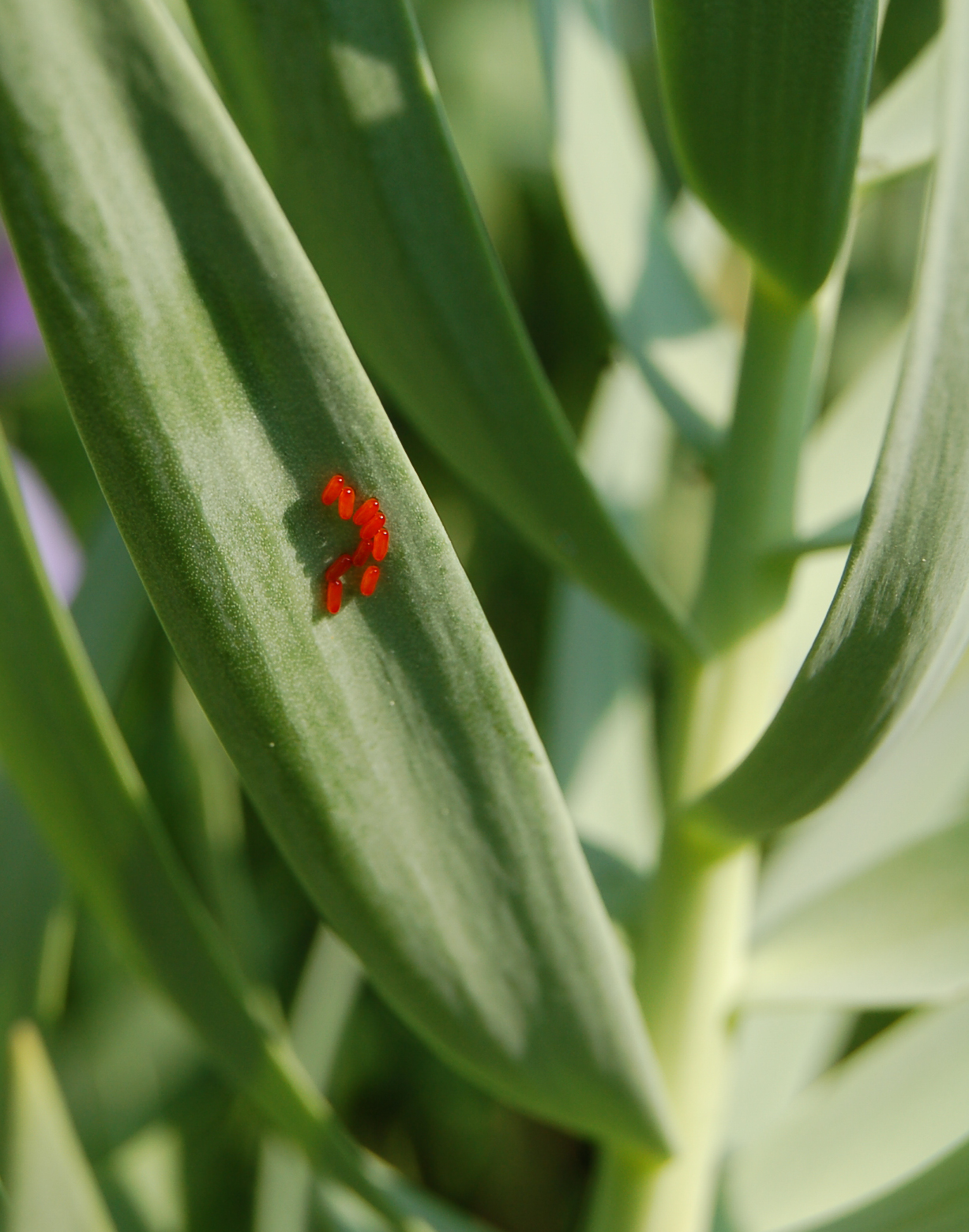
Now for my topical tip: look out for lily beetles. These smart red beetles will nibble your lilies and your fritillaries but worst of all they will lay copious quantities of little red eggs on the undersides of the leaves. These will hatch into disgusting grubs which cover themselves in their own excrement to discourage birds and humans from picking them off, and chomp their way through leaves and flowers in no time at all.

The Guilty Party II
If you are not squeamish about bugs (and if you are how can you be a gardener?) you must sneak up on the beetles, cup one hand underneath them and grab them with the other. If they see you coming they will drop off the leaves, fall to the ground and in true beetle fashion lie on their backs. Their fronts are black so you won't be able to find them.

You can't see me, can you?
Squash them, squash them now!
Once you have caught them hold them to your ear because they squeak. Don't let this soften your heart, you must squash them all. Do this daily if possible and squash the eggs too. There are sprays but it is hard to hit them and you will be wasting a lot of poison. If the grubs hatch you must remove them too (a squirt from the hose works quite well).


Keep on moving
I have found that keeping our pots of lilies in a semi-shaded position and only bringing them out into the bright sunshine when they are nearly in flower helps to stop the beetles from finding them. I think the sun makes the foliage smell more strongly and attracts more of the little so-and-sos. In this way the moveable feast that is pot culture adds outwitting beasties to its long list of advantages...