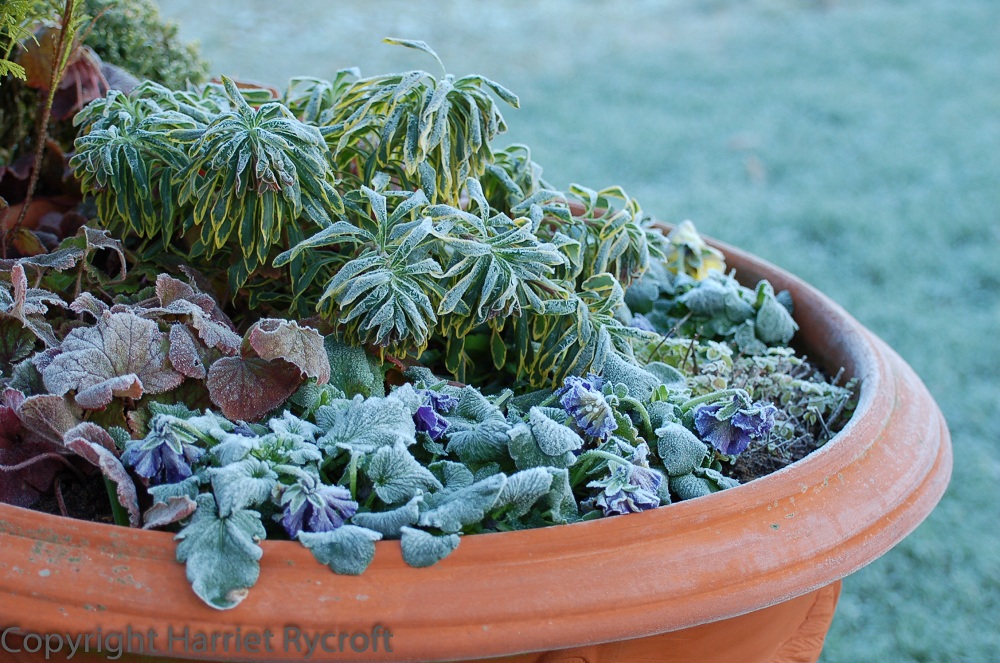
Friday, 27 January 2012

A Golden Crocus and a Golden Cypress

This week I have been working at home a lot, trying to catch up with paperwork: a backlog of orders for seeds and summer bulbs, this blog, and plant lists and picture collections for talks. Boring, but it has to be done.
I am, however, very excited to have been asked to speak at The International Specialist Nursery Days at Bingerden in the Netherlands this June - it's an event I have wanted to attend for years, and now I have my chance! I really hope that I will meet some of my readers from continental Europe there.
There are plenty of other events before that, so in order to avoid panic I have remained chained to my laptop for most of the week, while there is nothing requiring urgent attention in the garden.

Snowdrops, Vinca minor, Sarcococca confusa and Helleborus niger,
 a semi-permanent planting in a Geranium Pot

Helleborus niger and snowdrops
in a Marigold Pot
Old friends
I was at Whichford on Monday, however, and happy to see that the snowdrops (ordinary Galanthus nivalis) and Helleborus niger in the pots I planted a year ago are doing well. You can see that I have pulled out the weeds and top-dressed the pots with some fresh compost and a little slow-release fertiliser.

Crikey! I have just looked at the post I wrote about planting these pots and it is dated 14th February. Let's hope these early flowerers know what they are doing.

Rinkeni rakli
Last week saw our first iris open, and this year's earliest crocus flower is 'Gypsy Girl', just beginning to open this week. She is a gorgeous, golden yellow with strong, clear, rich reddish-brown stripes on the outside of her petals.

Crocus 'Gypsy Girl', first crocus to flower
at Whichford Pottery this year


So it would seem that spring is ready to pounce on us innocent gardeners and roll us about like a big invisible Tigger landing on Winnie the Pooh. Brace yourselves.


Keeping my promise
I did say a couple of weeks ago that I would show you more about Jim's Golden Cypress. He likes to tackle improbable projects and this one caused a real stir. The first Golden Cypress was made for an Impressionist-themed show garden in Japan, and is part of a series of sculptures.
The Golden Cypress at home at Whichford Pottery


Here's Jim talking about the inspiration for this work: "When I was four I suffered from a serious illness and for two months lay in a bed looking at van Gogh's painting of Wheat field with Cypresses, with all their writhing energies. When I was finally well enough to go outside to play I made a house for myself inside a venerable golden cypress tree. It remained my hideout all my childhood."

Aliens expected for tea?
Before we had heard this explanation all we saw at the pottery was Jim obsessively making flame-shaped sketches and clay maquettes, rather like an eccentric English version of Richard Dreyfuss in Close Encounters of the Third Kind.
Jim Keeling dwarfed by his own sculpture

We are used to odd behaviour at the pottery, but when he started work on a version 3.15 metres tall some of us thought he really had cracked this time. Bear in mind that the picture on the left was taken UPSTAIRS in the pottery. The kilns are downstairs.

Riv and Joe loading one of the kilns,
note the tight fit!


Well he just cut it into pieces, of course he did. It takes a special kind of confidence to spend days and days sculpting something huge and complex, only to saw it into segments and shove it in an oven.


Gold-standard teamwork

After emerging from the kiln the pieces were all then sprayed with a yellow ground by Chris and hand-gilded with 23.5 carat extra-thick gold leaf by Hilary and Lynda. You can imagine what an enormous surface area an object like this has!

All hands were then required to move the heavy pieces outside on a trolley and through the courtyard garden to the packing area. Placing the bottom segment on the sculpture's metal base was only possible with Dave's fork-lift skills and John and Brian's combination of teamwork, lateral thinking and brute strength.
Tricky business. From left to right, Dave, John, Brian and Jim.
Diving in. We were tempted to leave him there.
Jim is very lucky to have a team with so many practical and flexible skills between them. We tend to co-operate with him partly because we know he's quite clever really, but mainly because it can be funny...

On tenterhooks
More teamwork had the pieces fitted together. I watched with my heart in my mouth and my camera in my hand, ready to record the disastrous breakage - which never occurred. Once again he had pulled off a ridiculously improbable feat.
Go west, young man. Chris, Joe, Brian and Riv
help Jim to assemble the sculpture


After successful assembly, Jim sealed gaps and Hilary and Lynda carefully patched up any gilding which had been dislodged by all the manhandling.
Hilary and Lynda add the finishing touches

The first cypress to be made was sent to Japan, the second was sent up to Chelsea on a trailer to burn brightly on the Hillier stand (see my post about Chelsea 2011). Heaven knows what the motorists on the M40 made of it!
Cypress off to Chelsea
The Chelsea one has returned to Warwickshire and can still be seen at the pottery, it really is a fascinating focal point, looking different every day as the light changes.

Ta-dah! Jim with the Golden Cypress
on the Hillier stand, Chelsea Flower Show 2011

Tuesday, 17 January 2012

Preoccupations with ice and water

The days are getting longer, bulb shoots are popping up all over the place, but still I have been feeling uneasy.
Crocus 'Blue Pearl' emerging

Shadows on a Pearl Pot last week

What's wrong?
The sun has been shining, warming my back and casting crisp shadows on the pots but still I have cold shivers down my spine.


Spring has been galloping towards us, trailing flowers and green shoots, tempting honey bees to emerge and causing the birds to jostle for position and fly purposefully about with bits of twig in their beaks. The dunnocks have been chiming loudly and irritatingly in the hedge and the robin has been yelling above the noise of delivery vans going back and forth to the packing shed.

In spite of this something just was not right. Something was missing.
Our latest and loudest robin

Crunchy cure
Frost! Until last Thursday night we had not had a single hard frost, but then the skies cleared and cold air drifted over from Siberia. By Monday everything was frozen solid, the roads were slippery, there were chilblains on my toes, the end of my nose was as damp as a healthy dog's and I was wearing so many clothes it was hard to move at all. But I felt better.

Whichford looking cold but beautiful in the frost

My drive to work is always more picturesque than the average commute, but a sunny, frosty morning with a hint of mist is guaranteed to make me stop the car to take pictures. The photograph above shows the view as I come down into Whichford. You can see the distinctive pointed roof of the Octagon just below the two flying birds in the centre of the background.

Welcome to Whichford! Frost puts Puss-Puss in a good mood.
The cold seemed to make Puss-Puss extra friendly; it was impossible to focus my camera on him because he would not stop trotting towards me until he had had a really good stroking session. 

Clean cold
Winter isn't winter without a bit of frost; I think that as a gardener I feel soothed by it because the frost makes everything seem cleaner. In a way this is true, I have much less trouble from aphids and from fungal leaf spot on pansies if there have been a few good, hard frosts.

Monday morning: foliage and flowers slumped in despair

Pump up the volume
Hard frost makes plants seem to collapse, but on such a gorgeous, crisp day you can watch them pump up again as the sun gets round to them. As long as the frost isn't too sudden many hardy plants can survive it by pumping water out of their cells and into the spaces between the cells. Thus the cells are less turgid (leading to wilting of soft stems and leaves), their contents now have a higher concentration of sugars and solutes and are less susceptible to freezing and rupturing. When the temperatures rise again the water can re-enter the cells by osmosis.
I hope that is a satisfactory explanation - I am open to correction/clarification by people who really know their scientific onions... With all that delicate cellular hydraulic action it makes sense to keep your hands off the plants when temperatures are plunging.

Monday afternoon: all is perkiness again as the temperature rises a few degrees
Forget puritanical plainness!
I also love the way the frost shows off the decorative detail of the pots. For my own garden I always used to select quite plain pots, partly because if I'm honest I have the remnants of an instinctive mistrust of ornamentation (I think this is a rather English trait), and partly because plain pots are cheaper. Nowadays, however, I know that even a little ornament can be hugely valuable, especially in the dead of winter; I particularly like these vine pots, and the basket pots are a classic which combines well with anything.

Frosty Vine Pots and Basket Pots in the stockyard at Whichford Pottery

Even without plant-based visual entertainment the sparkle added by frost to the detail of an empty Sassanian Jar makes a proper bit of winter worth while.

Frost sparkles on the shoulder of a Whichford Sassanian Jar

Iris 'Halkis'
Stop Press! You may need to water your bulbs. For us this has been a very dry winter, and I have already had to water some of the pots  a couple of times, especially during windy weather and if the pots are close to buildings. If you have planted bulbs, particularly narcissi and tulips, in your pots please make sure that, when they are not frozen, you check to see that they are not too dry. Our bulb expert from Holland, RenĂ©, reminded me recently to remind everyone to water their bulbs. I have done this on Twitter and I'm saying it again here because lack of water in Jan/Feb can cause your bulbs to abort their flowers.
So when the compost has defrosted please stick a finger right into your pots and if it doesn't feel nice and damp then get your watering can out. If your pots are from Whichford the drainage will be good and you don't need to be afraid of giving the plants too much water.

I must admit that I am aching for flowers, and I was delighted to see a lone Iris 'Halkis', a brave little pioneer which opened over the weekend - there is so much more to come!

Monday, 9 January 2012

May I introduce you to Our Great Leader?

Happy New Year! Here we all are with our noses pressed firmly against the grindstone once more.

Jim trying to decipher my handwriting
The Big Cheese
I have decided to do an occasional series introducing you to some of the people and processes at Whichford Pottery and it seems logical to start with Jim Keeling - the man with whom the buck stops. He is the founder of and, after 35 years, still the main creative force behind Whichford Pottery. This is not a comprehensive, balanced view, it is Jim as I see him!

I took the photo on the right when we were working on the planting plan for a show garden. He likes to say that he taught me everything I know about gardening - but I don't rise to that one any more, I know that he still needs me to remember the plant names, their colours and where they like to live. Best of all he just lets me get on with the gardening and doesn't interfere. Well, not much anyway.

We argue about colours, pruning, compost making... This is a part of his 'management' style - friendly argument amidst creative chaos. It usually works.
His employees find him both infuriating and entertaining and we treat him with a healthy disrespect which he seems to tolerate, even to encourage.

The Keelings' garden at Whichford
Jim and his wife Dominique have a beautiful, rambling, family garden at their house next door to the pottery. It is open once a year under the NGS scheme and occasionally for special Whichford Pottery events.

Jim enjoys gardening, he is fast and messy and has enormous flair. When I came to work for the pottery he taught me how to plant flowerbeds randomly and encouraged me to plant pots extravagantly, once telling me what I had done was "prissy". That still rankles, to be honest.

Big is Beautiful
Most of all, of course, Jim is a potter. He has written elsewhere about his early inspiration and training so I'll just tell you a little about what he does at the moment.
Over the last few years he has refined his methods of making truly enormous flowerpots, more details of which you can find here: http://www.whichfordbespoke.com/super-large/
I am talking pots you can fit a whole family in (or, if you are being sensible, a large tree).


Huge Karatsu Pot
There are other names for it.

In the photo below he is preparing the clay for throwing one piece of a three-piece pot .


Massive pots are thrown on the wheel like the other pots but in sections which are joined together, one on top of the other. This requires a lot of strength and extremely accurate throwing skills. Then the pot has to dry (without cracking) before being moved downstairs and fired in the kiln (without cracking). I still find it completely astonishing that the Whichford team can now produce these consistently well.

Jim dabbling in slips and glazes in his studio
Jim still enjoys making smaller things; he and Dominique are well known for their sgraffito ware, which Jim throws and Dominique decorates. Jim also likes to experiment with wood-fired kilns (leave him unsupervised for five minutes and he'll build another one) and different techniques and styles, many inspired by visits to Japan.

Big in Japan
Ah yes, Japan. We sell many flowerpots in Japan and have wonderful, faithful customers there. This gives Jim the opportunity to go there regularly, which he loves. I have been twice and I love it too, but Jim really throws himself into it. He enjoys the culture, the great ceramic traditions and the love of craftsmanship.

Admiring a collection of tea bowls in a private house in Kyoto
Oishii desu ne!
He also takes full advantage of the hospitality. I thought I was doing pretty well, eating (and enjoying) unfamiliar japanese foods but my revered boss munched his way through everything and anything, jet lag or no jet lag. He even seemed to love the mamushi sake he was served in one bar, which had a snake in the bottom of the bottle. I had a sip - tasted vaguely fishy, not a taste I enjoy in an alcoholic beverage.
It wasn't designed for ladies anyway, the bar owner explained: it is supposed to increase virility.

Mr Big
Back in Britain, sculpture is another string to Our Great Leader's bow. He recently made an enormous statue of Humphry Repton for Alan Titchmarsh and has created quite a few other figures, some of whom lurk at the pottery and on murky evenings make me jump. Again, see http://www.whichfordbespoke.com/figurative-sculpture/

Is the resemblance between Jim and Humphry Repton coincidental?
The Big Idea
Jim also makes more abstract sculpture, some of which I don't understand, some I find absolutely stunning. I'll save the Golden Cypress Tree for another post because I have so many good pictures of the creation process, too many to squeeze in here. Let me just say that it was yet another occasion when we all scoffed and said,"It'll never work" and of course he managed it. Here's a scaled-down version of it in Jim's garden:


 If you are looking for him at this time of year just follow the sound of choral music to his studio, which is tucked behind the kilns. This room, littered with sketches, postcards, shards of Roman pottery, Japanese sake cups and home-made tools all covered with a fine layer of clay dust, is where he's working on the latest range of pot designs. Here's a little video to give you a small glimpse, my apologies for the lousy camerawork, it was my first go with the pottery's camera!

Tuesday, 20 December 2011

Snow, Angels and Stocking Fillers

Vile sploshy sleety chilly weather.
I retreated to the pottery to take this photo of
the stock yard on Tuesday

I try to avoid getting soaked in the morning so that I don't have to be chilled all day, so before break I lurk in the greenhouse checking on my cuttings, picking over the bigger plants and watering sparingly.

The entrance arch at the Pottery this week


Potting on and on and on...
Like the little lady on my Austrian weather house I pop out when the showers ease up and grab a few small pots to plant in the relative warmth of the greenhouse. Yes I am still planting.

This winter's planting in the Great Warwick Pot
Tulip 'Princesse Charmante'  lurks beneath.
Almost all of the bulbs have found homes now. All the big plantings have been finished and are out there fending for themselves.

Nevertheless on rainy days I have been adding small potfuls to the collection. Not all of my plantings are crammed with bedding and perennials. I like to do a few simple things too. Pots are great for focusing on small, unusual plants - those plants are also less likely to get lost in a busy garden.

True grit
For example the little rose bowl in the picture below just has Muscari 'Pink Surprise' (a present from RenĂ©) in it; the grit dressing keeps it looking neat, stops the compost from getting compacted by the rain, keeps the drainage sharp around the emerging shoots, wards off slugs, mice and squirrels, and generally fosters a sense of satisfaction in the gardener. I never seem to have enough grit and gravel. I hope Father Christmas isn't listening - I draw the line at getting grit in my Christmas stocking.


Small Rose Bowl simply planted with Muscari 'Pink Surprise'

Small Ali Baba jar planted with Allium karataviense 'Ivory Queen'
Fat and full
When I picked up this dear little fat ali baba jar I really wanted to do something clean and simple in it. The layer of pebbles looks nice enough by itself for the moment.  Next spring should see the emergence of Allium karataviense  'Ivory Queen', with smooth, sculptural leaves and buds, followed by white tennis-ball flowers. I am hoping that their clean lines will complement the jar.
Allium karataviense in bud
last spring
Pots in pots
Ali-baba jars are tricky to plant - you have to avoid planting these with vigorous-rooted plants or plants which hate root disturbance because it will be difficult/impossible to extract them when they need moving on. You either need to half-fill the jar with polystyrene and then plant something which can be taken out easily (disposable bedding or dormant bulbs) OR you can place another pot in the top of the jar and plant that. This insert method works very well in the large jars because they have plenty of room for a decent-sized pot.

The picture below shows part of this winter's courtyard display - the Giant Jar has another pot in the top, so that it can be planted, but it would look just as good empty or with some spectacular branches or seedheads arranged in the top.
The pot in the top of the Giant Jar contains Calamagrostis 'Overdam', a Euphorbia seedling and
 2 x Vinca minor 'Argenteovariegata', plus Tulipa 'Picture', Narcissus 'Rip van Winkle',
Crocus tommasinianus 'Roseus' and Pansy 'Can-Can'
I really shouldn't say this but at this time of year I think the pots look just as good empty - the low sunshine (when we get it) shows off the details beautifully and makes the terracotta glow.

Shallow basket pots in the stockyard at Whichford Pottery
The Birds
On Thursday the weather had calmed and as a result there were birds everywhere, stuffing their faces as fast as they could before the next bout of sleet. I wandered about with my camera for twenty minutes and in that time I saw redwings, fieldfares, bluetits, great tits, robins, coal tits, long-tailed tits, a green woodpecker, pigeons, rooks, a buzzard, blackbirds, a bullfinch, a linnet and I could hear pheasants and a mistle thrush. Not bad.

We have a little patch of mixed woodland planted about 15 years ago behind the pottery, it has been left fairly dense, with some paths cut through it and is a great place to go for a moment of peace and quiet. This is where I saw most of the smaller birds, including my very first linnet, looking exotic with his pretty pink chest.
My first linnet
Noisy boys
I am rather fond of the fieldfares, with their smart plumage, noisy chatter and boisterous behaviour. They are the naughty but charming boys at the back of the class. I saw this fieldfare and his mates from the top of the steps above the clay pile.
 
Fieldfare perch

My perch

I was lucky to catch this picture as it jumped to reach some berries - looking positively angelic:
Fieldfare angel
 Vintage ladybirds
And finally: John (our driver/packing expert) after much hinting and smirking (very worrying considering his usual sense of humour) produced this little heap of delights:
Santa/John brought vintage Ladybird Books
People my age will have fond memories of Ladybird Books. I think this is mainly for the vivid illustrations; my husband and I both remember 'Garden Birds' but 'Trees' and 'Garden Flowers' are both new to me. I like the pleasant clarity of the pictures and the brief, unpatronising text where no effort is made to make the facts either cool or amusing. I shall be studying them more closely but have already learned that the Horse Chestnut gets its name from the fact that it is a 'coarse' or 'inferior' type of chestnut and that pelargoniums "can only be grown in pots". Well, there you have it.

Wishing you all a Merry Christmas and a Happy New Year!

Friday, 9 December 2011

Signs of spring, fruits of autumn, chills of winter

Here come the crocus shoots!

Crocus shoots are up already

Solanum not yum
I have carried on stuffing the greenhouse and polytunnel with tender and tenderish plants, the mild weather has allowed us to save even more plants than usual, touch wood. Solanum laciniatum has managed to ripen a few fruits (see my post of 12 Sept) which turn out to be orange. I'm pretty sure they are poisonous, so I won't be reporting on their taste.
The fruit of Solanum laciniatum - not for human consumption

The polytunnel is fairly full now, but I'm trying not to overcrowd it so that air can circulate, I have cut most foliage back by at least half for the same reason. Last year I didn't get the chance before the Big Freeze and we had galloping grey mould as a result.
Still room to circulate in the polytunnel


Clustering bugs
Plants aren't the only things to take refuge in here:
Ladybirds on Solanum quitoense inside the polytunnel

I hope our 'traditional' ladybirds are going to overwinter successfully - they may have tricky times ahead because Harmonia axyridis or the Harlequin ladybird is definitely here and it remains to be seen whether the invader will, as is rumoured, outcompete our native ladybirds.
One of the Harlequin ladybirds I found this summer

Lily potting
On Monday I thought I'd give Donna a break from digging up dahlias and got her to pot up some lilies. We have a wide range of lily pots and at the moment we have a special mail-order offer featuring Lilium 'El Grado' and Lilium 'Mona Lisa', so we have a plentiful supply of nice fat bulbs.

Nice fat lily bulb
Pots of lilies are really useful for providing splashes of colour just before the tender bedding and perennials go completely berserk. 'El Grado' (see post of 23 July) is a deep, rich reddish pink, whereas 'Mona Lisa' (see post of 8 August) is white, blushing to pink, with a deep pink stripe in the centre of each petal and attractive pink freckles and exuding a fabulous fragrance.
A lily pot and lily bulbs makes a great Christmas present, by the way!

Five bulbs fit neatly in a lily pot
I plant lilies a good five or six inches deep, using the same multipurpose peat/loam/grit mix I use for everything, with an extra sprinkle of slow-release fertiliser. The tall, narrow pots give excellent drainage, but you must be careful not to put the pot somewhere where drips from a tree or a roof will keep it constantly wet. They can stay outside all winter (even last winter), they just don't want to be soggy.

Donna shakes the compost down
We then top up the compost to about an inch below the rim of the pot, give it several good hard taps on the ground (don't put your hands in and squash the compost down, you'll ruin its structure and impede drainage and aeration), and water in. An inch of grit as a mulch will help to stop the surface of the compost from forming a water-resistant cap and will make the pot look neat.

You can plant lilies under other plants but I usually keep mine separate just because it is easier to remember where they are. It is also an idea to repot them every winter in order to keep the number of overwintering lily beetles down. See my post of 21 April for pictures of those pesky red critters.

Dried fish with your coffee?
In other news, Jim is back from a visit to Japan. He traditionally brings back a selection of Japanese snacks, some of which are more popular than others. The wasabi-flavoured KitKat definitely went down better than the dried fish this time. It might help if any of us could read Japanese.

Japanese snacks at staff tea-break. The fish was fragrant...

Midwinter blog dog
The weather has at last started to feel wintry. This makes me and Hooley miserable. Hooley is Joe's dog, a labrador/staffy cross, she has a melancholic disposition and she feels the cold. Luckily Joe has an assortment of small children as well as a dog, so this week Hooley arrived looking much happier in a shirt and jumper. She didn't mind us laughing at her.

Hooley looking almost cheerful now she is appropriately dressed